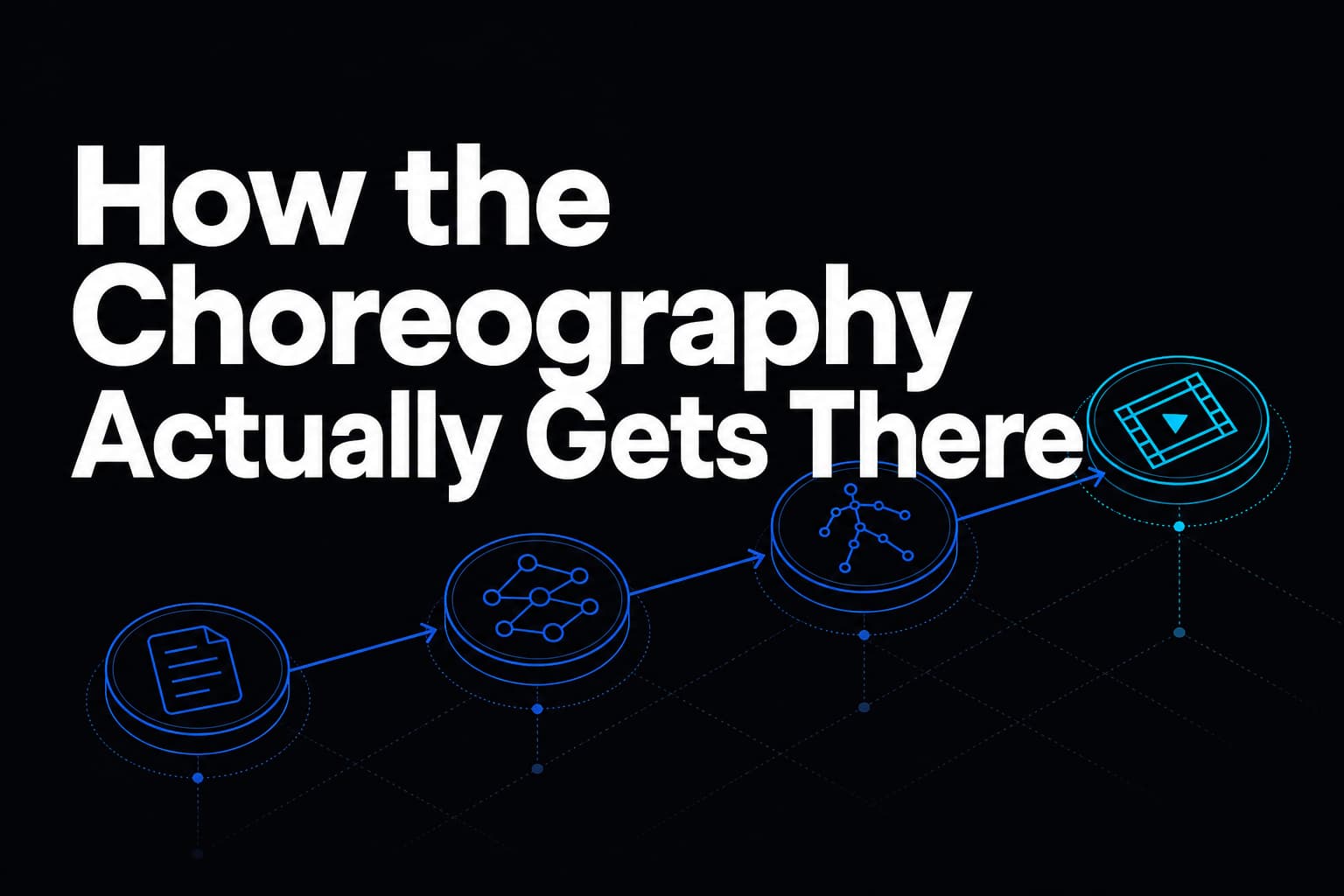
The AI Baby Dance Trend: How the Choreography Actually Gets There
Toddlers hitting complex choreography with unsettling precision is two models in sequence, not one. The pipeline, why the uncanny precision is the joke, and where it goes wrong.
The current dominant version of the AI baby format is not the podcast one — it is babies performing adult choreography with impossible precision. The comedy is entirely in the mismatch: a body that should not be able to do this, doing it perfectly.
That mismatch is also the technical description of the pipeline.
Two models, in this order
Step 1 — the character. Generate a photorealistic baby in a setting, as a still. This is an image job, so iterate here: fal-ai/nano-banana-2/edit at $0.08 per image or fal-ai/nano-banana-pro/edit at $0.15 (read 2 August 2026).
What to specify: full body in frame, feet visible, standing, neutral pose, plain background. Every one of those matters in step 2, and none of them is what an image model gives you by default.
Step 2 — the choreography. Motion transfer from a reference dance clip onto that character: fal-ai/kling-video/v3/pro/motion-control at $0.168 per output second, or the Standard tier at $0.126. Both re-checked 4 September 2026, unchanged.
Set character_orientation to video. On that setting the reference clip drives the framing and the face-binding element works; on image the binding is a silent no-op and you get drift you paid for.
An 8-second clip: about $1.34 plus a few image attempts. Under two dollars for the finished thing.
Why most attempts look wrong
The still was cropped. A dance uses legs. If your generated baby is framed at the chest, motion transfer invents the lower half and the invention is where the eye goes.
The source dance is too busy. Rapid direction changes and floor work transfer badly. Pick a section with clear, repeating, upright movement — which is also the section viewers recognise.
Too long. Five to eight seconds. The joke is over by then anyway, and drift compounds past that.
Proportions fight the choreography. Adult choreography on infant proportions is the whole gag, but the model has to reconcile limb lengths that do not match the motion path. Simpler movement reconciles better, and simpler movement is funnier here.
The part worth being careful about
Rendering a specific real person as a baby is where this format gets people reported. Platform rules on manipulated media and likeness apply regardless of comedic intent, and several models refuse real-person likenesses at the API level. A generic baby is both safer and, in practice, funnier — the joke is the choreography, not the target.
Also: TikTok and Meta both auto-label AI content, and TikTok's detection uses C2PA provenance metadata plus classifiers looking for exactly the artefacts this format produces. You are not going to slip an obviously generated baby past that, and there is no reason to try — the format is openly synthetic and nobody is deceived.
Shelf life
This one is burning fast. The baby podcast version had a run, the dance version is having one now, and the next variant is already being tested somewhere. The durable skill is the pipeline — still first, motion second — because it applies to whatever the next character format is.