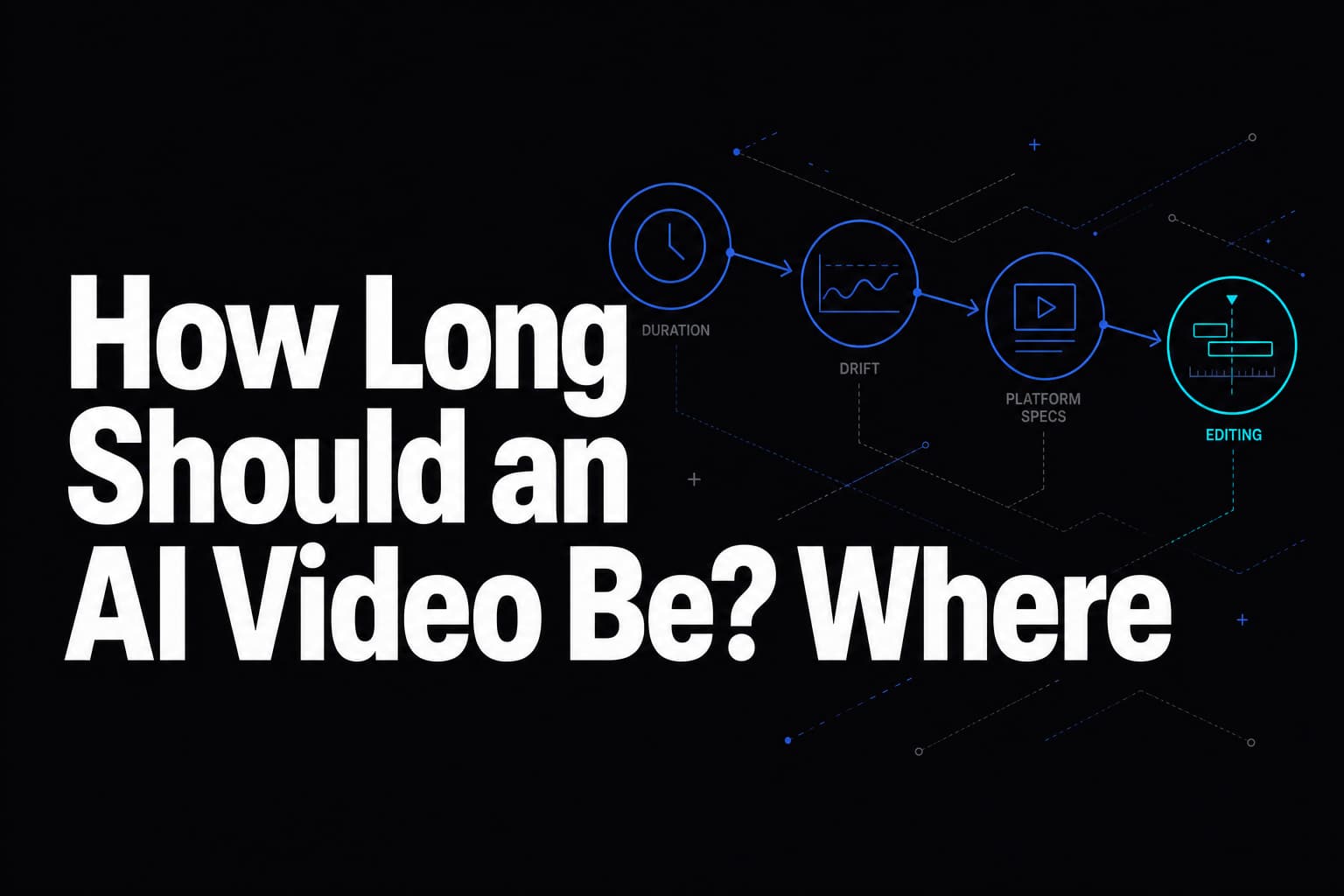
How Long Should an AI Video Be? Where Model Limits and Platform Rewards Agree
Generated clips hold quality for five to eight seconds. Short-form platforms reward seven to thirty. The overlap is the whole answer, and it means building longer pieces from cuts.
There are two separate constraints on length and they happen to point the same way, which makes this one of the few decisions in AI video with a clean answer.
Constraint one: the model
Identity drift is a function of duration multiplied by motion amplitude. A face is stable at the start and progressively less itself later — wardrobe shifts, features soften, hair changes.
In practice:
- 3–5 seconds — reliably clean, even with movement.
- 5–8 seconds — the working band. Stable if the motion is restrained.
- 8–15 seconds — visible degradation on most models, especially with big gestures.
- Beyond 15 — most endpoints do not offer it, and where they do, you should not want it.
Model caps reflect this. HappyHorse 1.1 Reference to Video runs 3–15 seconds and defaults to 5 — that default is good advice, not a limitation. Wan 2.7 Edit Video accepts 2–10 second inputs.
Constraint two: the platform
Instagram Reels run to 90 seconds in the standard flow, but reach peaks in the 7–30 second band. TikTok accepts up to 60 minutes on upload while engagement peaks at 15–30 seconds. YouTube Shorts run to 3 minutes.
So every platform rewards roughly the same window, and it is wider than what a single generation holds.
The resolution: build from cuts
A 24-second Reel is not one generation. It is three to five shots of five to eight seconds each, cut together.
This is better on every axis:
- Quality. Each shot is inside the stable band, so nothing drifts.
- Cost. Identical. Twenty-four seconds is twenty-four seconds — at $0.14 per second that is $3.36 whether it arrives as one clip or four.
- Editing. Cuts create pace. A single continuous shot of a person talking is the least engaging thing you can put on short-form.
- Recovery. If one shot fails, you re-run six seconds, not twenty-four.
The one place a long single take genuinely wins is continuous camera movement through a scene, and that is a specialist requirement rather than a social-video one.
Practical planning
| Piece | Structure | Model cost at $0.14/s |
|---|---|---|
| 8-second hook | 1 shot | $1.12 |
| 15-second clip | 2–3 shots | $2.10 |
| 24-second Reel | 3–4 shots | $3.36 |
| 45-second Short | 6–8 shots | $6.30 |
Cheaper per second on non-face content: Kling 2.6 Pro at $0.07 or LTX 2.3 at $0.08 roughly halve those figures. Prices checked against the live endpoints on 3 August 2026.
Two more length notes
Put the payoff first. Short-form algorithms weight watch time, so a clip that takes three seconds to establish itself has already lost. This matters more for generated content, where a viewer's first instinct is to decide whether it is worth watching at all.
Do not pad to hit a number. There is no length the algorithm rewards for its own sake. An eight-second clip that works beats a thirty-second one that was stretched — and it costs a quarter as much to make.