HeyGen vs sync for Lip Sync: $6, $5 and $8 a Minute Compared
Three lip-sync endpoints priced within a few dollars of each other but billed in different units. What each is built for, and why the cheapest is not always the one you want.
Dedicated lip-sync — take footage you already have, make the mouth match different audio — is a small, mature category with three serious options. The prices look close and the billing units are not, which is where the confusion starts.
Prices checked against the live endpoints on 3 August 2026.
The three
| Model | Billed | 60-second clip | 3-minute clip |
|---|---|---|---|
| sync 2.0 Pro Lipsync | $5.00 per minute | $5.00 | $15.00 |
| HeyGen v3 Lipsync (Precision) | $0.10 per second | $6.00 | $18.00 |
| sync-3 Lipsync | $8.00 per minute | $8.00 | $24.00 |
HeyGen bills per second, sync bills per minute. On a 61-second clip that matters: per-minute billing typically rounds up, so you pay for two minutes.
For short social clips the per-second endpoint is therefore cheaper than its headline suggests, and for anything that lands just over a minute boundary it is meaningfully cheaper.
What each is for
sync 2.0 Pro — the value option at $5.00/minute. Solid general-purpose lip-sync for talking-head footage.
HeyGen v3 Lipsync Precision — per-second billing, precision tier. The right default for social-length clips because you are not rounding up to a minute you did not use.
sync-3 — the premium tier at $8.00/minute, positioned for 4K and demanding footage. Worth it when the mouth fills the frame.
The question you should ask first
Do you need lip-sync, or do you need translation?
They are different products and people buy the wrong one regularly. If the job is "same speaker, different language, keep their voice", that is HeyGen v2 Translate at $0.05 per second — $3.00 per minute — and it does translation, timbre preservation and lip-sync in a single call. Buying dedicated lip-sync plus a separate translation step costs more and gives you two failure modes.
Dedicated lip-sync earns its keep when the audio already exists in the target language: a re-recorded voice-over, a dub you commissioned, a cleaner take of the same line.
And if you have no footage at all
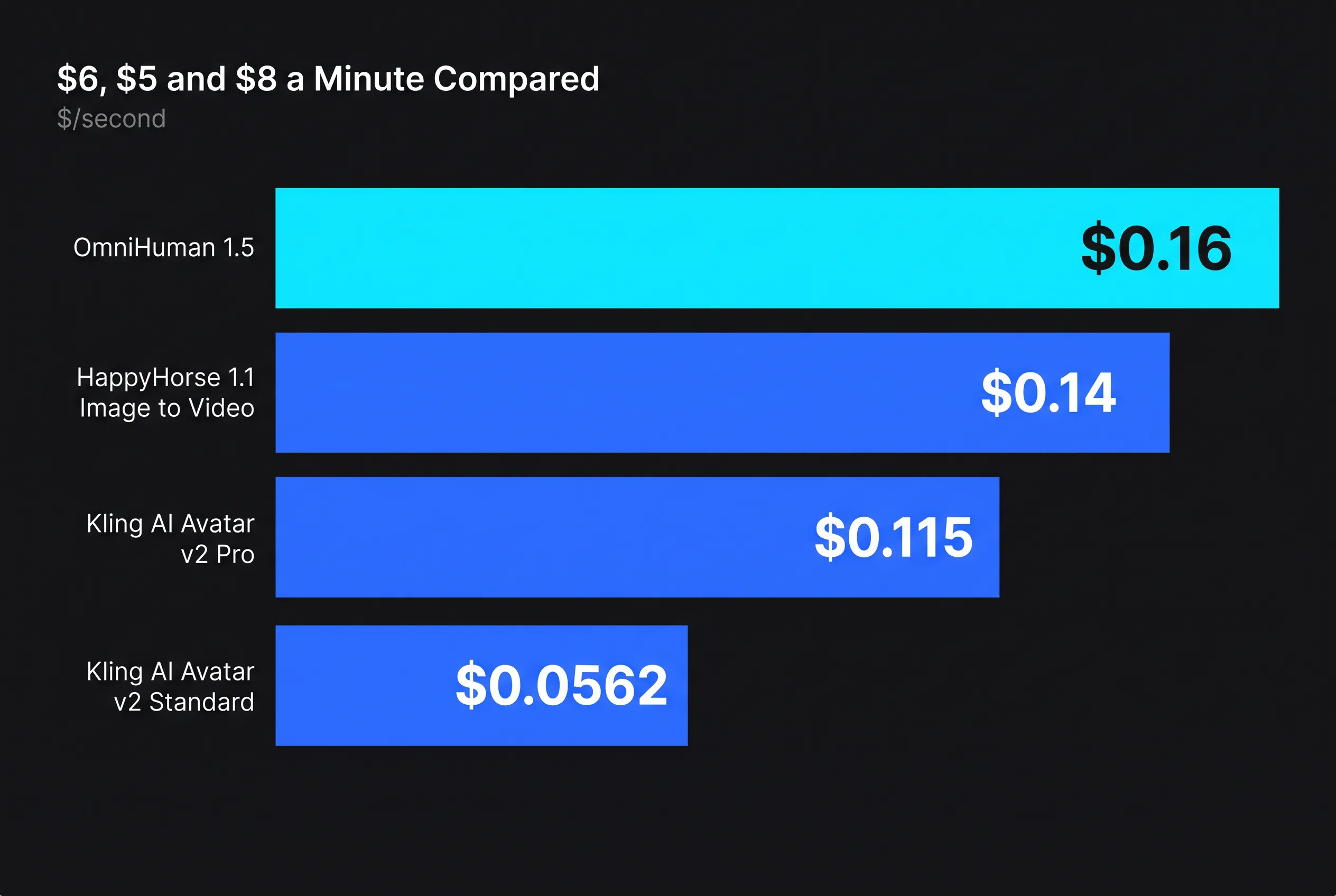
Then none of these apply — they all modify existing video. Generating a talking clip from a photo is a different family and much cheaper:
| Model | $/second | 60s |
|---|---|---|
| Kling AI Avatar v2 Standard | $0.0562 | $3.37 |
| Kling AI Avatar v2 Pro | $0.115 | $6.90 |
| OmniHuman 1.5 | $0.16 | $9.60 |
| HappyHorse 1.1 Image to Video | $0.14 | $8.40 |
Where quality still breaks
Sync accuracy degrades over long continuous footage on every tool we have tested — reported degradation after a couple of minutes is common. Profile and three-quarter angles are harder than frontal. And languages whose mouth shapes differ substantially from the source are harder than the major European pairs.
Test at your real production length, not on a 20-second sample. A tool that is flawless in a demo is not thereby fine at six minutes, and that is the specific way this category disappoints people.