Kling 3.0 vs HappyHorse 1.1 for Character Replacement (August 2026)
Two very different ways to put a person into an existing video. Per-second prices from the live endpoints, what each model actually accepts as input, and which one to pick per scenario.
"Character replacement" is used for two jobs that need different models: motion transfer (keep the movement of a reference clip, swap the performer) and reference-driven generation (build a new shot around a person you supply). Kling 3.0 Motion Control does the first. HappyHorse 1.1 does the second. Picking the wrong one is the most common reason people conclude "AI character swap doesn't work".
Prices as of 2 August 2026
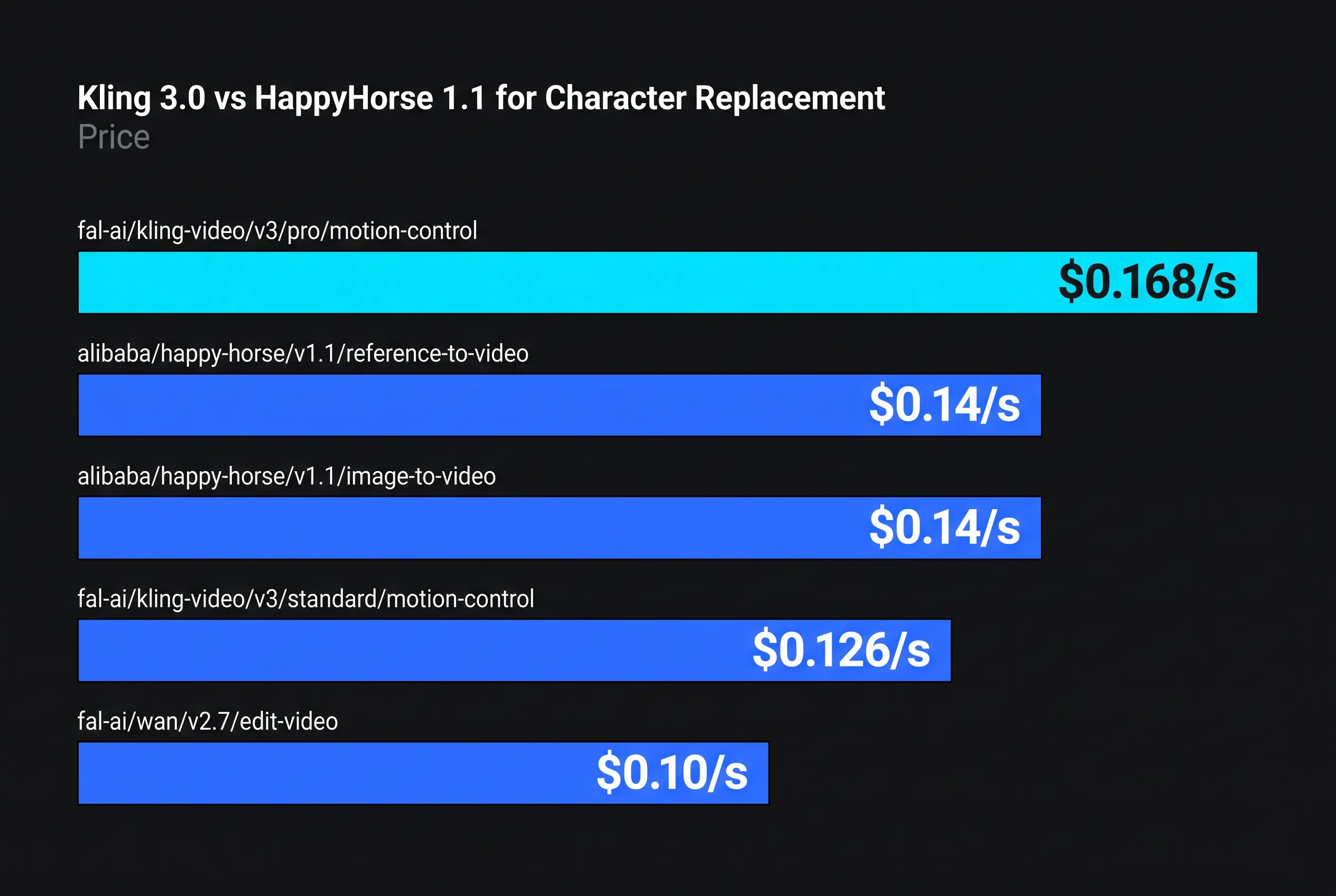
Per-second list prices, read from the fal.ai endpoints on the date above.
| Endpoint | Job | Price |
|---|---|---|
fal-ai/kling-video/v3/pro/motion-control | motion transfer | $0.168/s |
fal-ai/kling-video/v3/standard/motion-control | motion transfer | $0.126/s |
alibaba/happy-horse/v1.1/reference-to-video | refs to new shot | $0.14/s |
alibaba/happy-horse/v1.1/image-to-video | animate a photo | $0.14/s |
fal-ai/wan/v2.7/edit-video | video edit with a reference image | $0.10/s |
A 10-second clip is therefore $1.68 on Kling Pro motion control, $1.40 on HappyHorse, $1.00 on Wan 2.7 edit. Nothing here is priced per "credit", so the cost is knowable before you press the button.
What each one actually takes as input
Kling 3.0 Motion Control wants a reference video (3–30 seconds) plus a character image. It extracts the motion path and re-performs it with your character. The parameter that decides everything is character_orientation: with video, the reference clip drives framing and the model accepts an elements entry that binds the face. With image, the framing follows your still and that facial binding is silently a no-op — which is exactly the configuration people complain about when identity drifts.
HappyHorse 1.1 has three endpoints — text-to-video, image-to-video and reference-to-video — and no video-edit endpoint at all. Reference-to-video takes up to nine images of your character and a prompt, outputs 1080p in nine aspect ratios including 9:16 and 4:5, with native audio and multilingual lip-sync. It does not ingest a source video, so it cannot copy a clip's choreography.
That single line is the whole decision: if the movement has to match a specific existing clip, HappyHorse cannot do it.
Where each one wins
| Scenario | Better pick | Why |
|---|---|---|
| Dance / choreography copied from a Reel | Kling 3.0 Motion Control Pro | only one of the two that ingests motion |
| Talking head, your face, your script | HappyHorse 1.1 i2v | native audio and lip-sync in one call |
| "Me in a scene I describe" | HappyHorse 1.1 ref2v | up to 9 refs, true 9:16 output |
| Narrative clip where the background must stay | Wan 2.7 edit-video | keeps the source video, swaps the performer |
Two field notes from our own runs. Kling Motion Control's Pro tier holds faces visibly better than Standard — the 33% price gap is worth it when the face is the point. And on HappyHorse, drift grows with motion amplitude: five seconds of restrained movement stays clean where ten seconds of big gestures starts sliding.
The honest caveats
Kling's real-face policy allows public figures but is not blanket permission — a rejection is a policy decision, not a bug.
HappyHorse defaults to a 16:9 aspect ratio, so a vertical creator gets a landscape clip unless they set aspect_ratio to 9:16 or 4:5. Resolution is billed at the same flat per-second rate either way, so the cost of missing this is a wasted generation rather than a bigger invoice.
And neither is a face-swap tool in the inswapper sense: they regenerate the person, so wardrobe and proportions come from your references, not from the source clip.