AI Video Generation Pricing Compared (September 2026): What a Second Really Costs
Per-second API prices for the video models worth using in 2026, what the same clip costs on each, and why credit-based consumer plans are usually the more expensive way to buy the identical model.
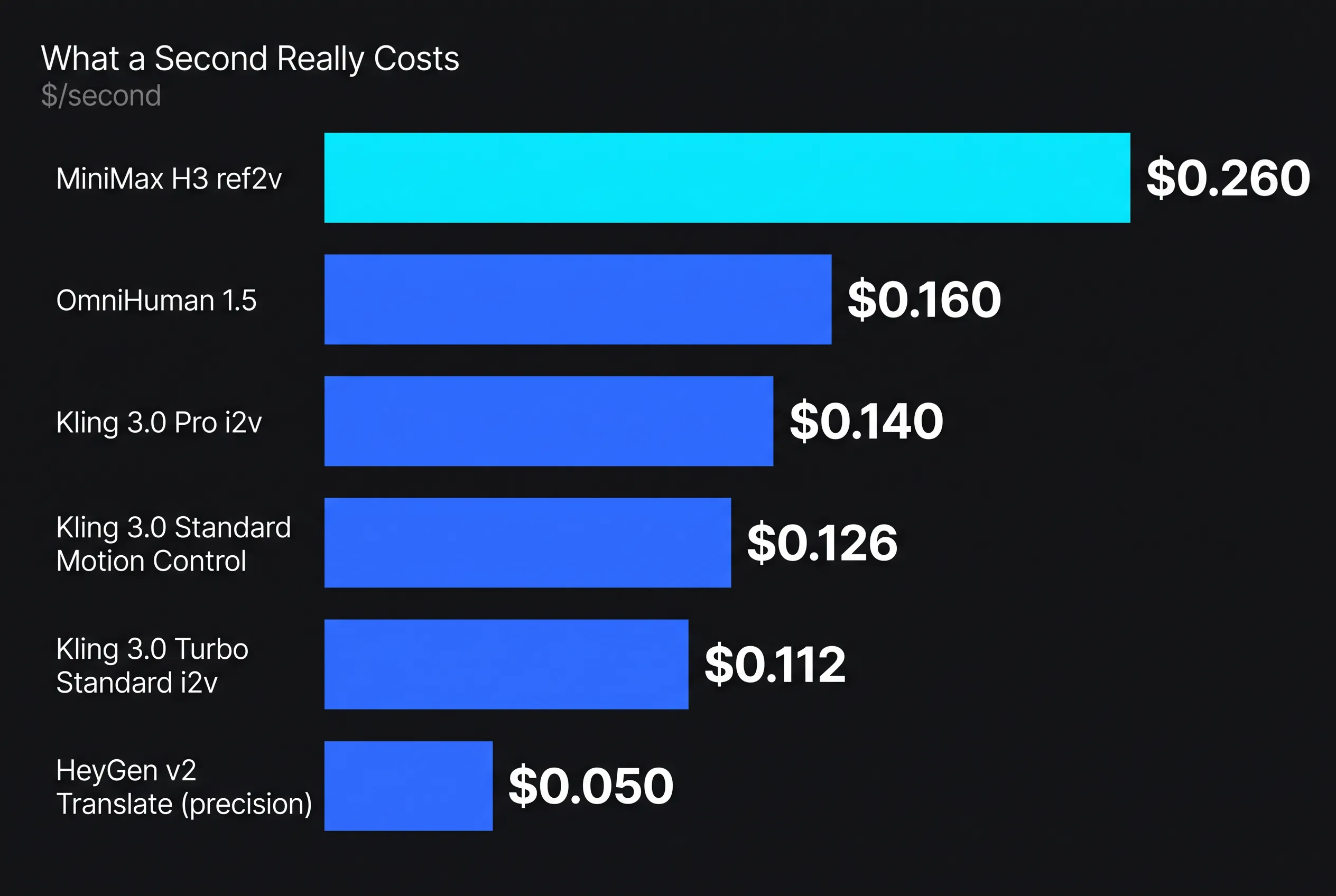
There are two ways to buy AI video in 2026: per second from an API, or per credit from a consumer app. The second is convenient and almost always more expensive, because the credit-to-second rate is rarely published and changes without notice. Here are the numbers.
Per-second API prices, read 4 September 2026
Every figure below was pulled from the live fal.ai endpoint on that date. Prices move; the endpoint IDs are included so you can re-check.
| Model | Endpoint | $/second | 10s clip |
|---|---|---|---|
| FLUX.3 draft (t2v / i2v) | blackforestlabs/flux-3/*/draft | $0.030 | $0.30 |
| Wan 3.0 Prime i2v / t2v | alibaba/wan-3.0-prime/* | $0.050 | $0.50 |
| One-to-All Animation 14B | fal-ai/one-to-all-animation/14b | $0.060 | $0.60 |
| FLUX.3 t2v | blackforestlabs/flux-3/text-to-video | $0.085 | $0.85 |
| Wan 2.7 Edit Video | fal-ai/wan/v2.7/edit-video | $0.100 | $1.00 |
| Kling 3.0 Turbo Standard i2v | fal-ai/kling-video/v3/turbo/standard/image-to-video | $0.112 | $1.12 |
| Kling 3.0 Standard Motion Control | fal-ai/kling-video/v3/standard/motion-control | $0.126 | $1.26 |
| Kling 3.0 Pro i2v | fal-ai/kling-video/v3/pro/image-to-video | $0.140 | $1.40 |
| HappyHorse 1.1 i2v / ref2v | alibaba/happy-horse/v1.1/* | $0.140 | $1.40 |
| OmniHuman 1.5 | fal-ai/bytedance/omnihuman/v1.5 | $0.160 | $1.60 |
| Kling 3.0 Pro Motion Control | fal-ai/kling-video/v3/pro/motion-control | $0.168 | $1.68 |
| MiniMax H3 ref2v | minimax/h3/reference-to-video | $0.260 | $2.60 |
| Kling Native 4K i2v | fal-ai/kling-video/v3/4k/image-to-video | $0.420 | $4.20 |
| Seedance 2.5 (any endpoint) | bytedance/seedance-2.5/* | ≈ $0.462 at 720p24 | ≈ $4.62 |
| HeyGen v2 Translate (precision) | fal-ai/heygen/v2/translate/precision | $0.050 | $3.00/min |
The August version of this table spanned 2.6×. The September one spans 15×, and both new ends are informative: Wan 3.0 Prime replaced Wan 2.7 at half the rate, while Seedance 2.5 bills in video tokens ($0.0214 per 1,000) that work out near half a dollar a second — and refuses real human faces, so the price buys stock footage. See the autumn model round-up for the full release list.
What that means for a real Instagram Reel
A typical Reel worth recreating is 8–15 seconds. At the prices above, the raw model cost of one vertical clip lands between $0.80 and $2.60. Add analysis, storage and retries and the true cost of a finished short video is roughly $1–4 in compute.
Consumer tools sell the same models at $9–49 per month with a credit pool, which is fine if you publish daily and terrible if you publish twice a month. The break-even is easy to compute once you know the per-second rate — which is the whole reason vendors avoid printing it.
Three pricing traps
Resolution and audio multipliers on credit platforms. Per-second API rates above are flat — the endpoint charges the same regardless of the resolution you request. Credit-based consumer plans are different: on Kling's subscription, a Kling 3.0 clip runs about 6 credits per second at 720p without audio and about 12 with 1080p and native audio. Two toggles, double the burn, and the rate is not shown next to the toggles.
Endpoints with no published price. Some models have no per-output rate in fal's pricing API — it answers with the platform's GPU-fallback rate, which is what it returns for anything missing from its pricing table. You cannot quote such a job to a user before it runs. We exclude these from production routing for exactly that reason — which now excludes most of a release cycle: MiniMax H3 Max, Gemini Omni Flash 1.1, the full Wan 3.0 tier, LTX 2.5 and Grok Imagine 1.5 all shipped in late August 2026 with no published price, and carry a per-job ceiling ($0.10–0.35) in our registry in place of one.
Expiring top-ups. Credit packs that expire in 90 days are now an industry norm. If your usage is bursty, a meaningful share of what you buy is never spent.
Cheapest is not the answer, matched is
Wan 3.0 Prime at $0.05/s is the cheapest full-quality option on the list — the FLUX.3 draft row is cheaper, but a draft tier is for proving a composition, not for publishing — and it animates a still — it has nothing to say about an existing clip. Wan 2.7 edit-video at $0.10/s is twice the price and the only one of the two that keeps your background. For a talking-head clip, both are the wrong tool: neither has anything to say about lip-sync from a script. HeyGen translate at $3.00/min looks expensive next to $0.14/s until you notice it does translation, timbre preservation and lip-sync in one call, which would otherwise be three billed steps.
The cost that matters is not $/second. It is dollars per usable clip, and that number is dominated by how many times you re-run a job because the model was a bad fit.