MiniMax H3 vs LTX 2.3: The Most Expensive Model Against the Cheapest
$0.26 a second against $0.08 — a 3.25x gap between two models doing nominally the same job. What the premium actually buys, and the large class of work where it buys nothing.
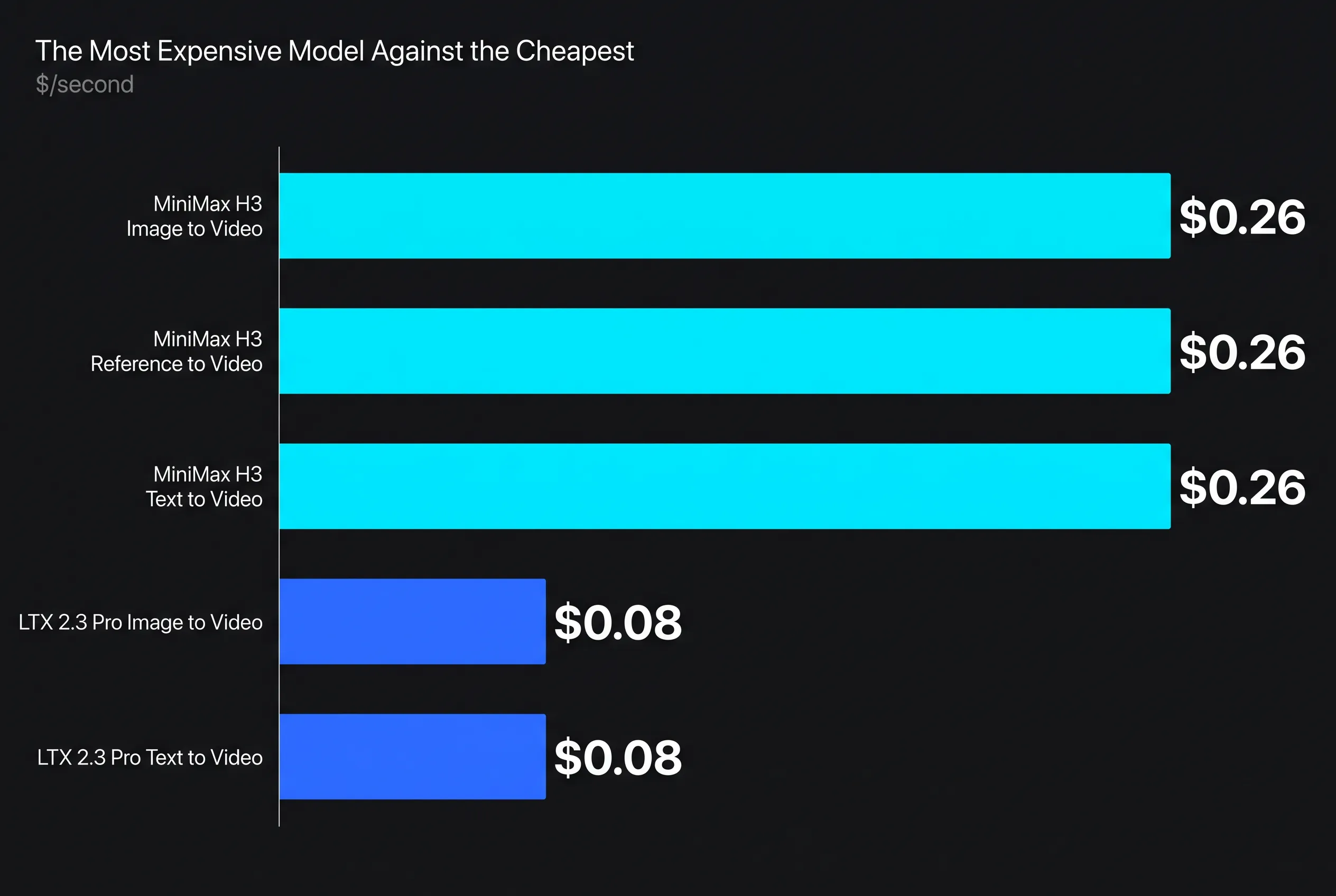
These sit at opposite ends of the price range, which makes them the most useful pair to compare — the gap between them is the clearest available answer to "does paying more for a video model do anything?"
Prices re-checked against the live endpoints on 4 September 2026.
The gap
| Model | $/second | 10s clip |
|---|---|---|
| LTX 2.3 Pro Image to Video | $0.08 | $0.80 |
| LTX 2.3 Pro Text to Video | $0.08 | $0.80 |
| MiniMax H3 Image to Video | $0.26 | $2.60 |
| MiniMax H3 Reference to Video | $0.26 | $2.60 |
| MiniMax H3 Text to Video | $0.26 | $2.60 |
3.25×. On a hundred clips that is $80 against $260.
Both families shipped a successor you cannot price
In late August 2026 MiniMax released H3 Max and H3 Max Turbo, and Lightricks released LTX 2.5 in Pro and Fast tiers. Neither generation is in the table above, because neither can be: fal's pricing API publishes no per-output rate for any of them — it answers with the platform's GPU-fallback rate, its standard reply for an endpoint missing from the pricing table. We carry a per-job ceiling ($0.10–0.25) instead, and you find out what a clip cost after it renders.
That is a real regression for anyone quoting a price to a customer, and it is why LTX 2.3 keeps its $0.08 rate in our catalogue while its successor cannot be quoted at all, despite being a generation behind. The autumn round-up lists the whole unpriced wave. If you want a quotable cheap rate that is newer, it came from a different vendor: Wan 3.0 Prime at $0.05 per output second.
What MiniMax H3 gives you for it
Released 31 July 2026, and the specification is genuinely ambitious: 2K output, up to nine image references for subject and style, plus reference clips for motion and audio, each addressable by position in the prompt. Durations 5–15 seconds across seven aspect ratios.
The multimodal reference set is the real differentiator. Being able to cite images and motion and audio in one prompt is a level of control the cheaper models do not offer at all.
It is also new enough that there is no meaningful body of independent user reports. We are describing capability, not a track record, and we have not run it against a controlled comparison ourselves. Treat it as promising rather than proven.
What LTX 2.3 gives you for $0.08
Competent, fast image-to-video and text-to-video at the lowest price in the active catalogue. No reference stack, no 2K, no motion citation.
For a very large class of work, that is the entire requirement.
The class where the premium buys nothing
No human identity in frame. Products, objects, landscapes, abstract motion, transformation effects. The expensive models spend their capacity on holding faces consistent; with no face, you are paying for capability that never activates. Use LTX 2.3 or Kling 2.6 Pro at $0.07.
Short clips watched small. Drift is a function of duration; at five seconds most models look similar. The premium shows up at length, and at length you should be cutting shots together anyway.
Iteration. Prove the composition and the motion on the cheap model, then re-run the keeper on the expensive one. At a 3.25× ratio, doing ten cheap attempts and one expensive final costs less than four expensive attempts.
Where the premium is defensible
A person who must stay recognisably themselves, from multiple reference photos, in a clip that will be watched full screen. That is what the nine-reference stack is for.
Even then, check the alternatives at $0.14: HappyHorse 1.1 Reference to Video and Kling O3 Pro Reference to Video both do nine-reference character work at roughly half MiniMax's price, and both have a track record.
The rule we use
Start at the bottom of the range and move up only when a specific failure forces you to. In this category, price correlates with capability far more than with quality, and most jobs do not need the capability.