Runway vs Kling: Credit Economies, Real Costs, and Which One Your Job Needs
Both are frontier video platforms sold on credits. Converting each to dollars per clip, where Runway's Aleph is unmatched, and where Kling's motion control simply has no Runway equivalent.
This is the top-tier comparison in the category, and it usually gets answered on vibes. Both publish enough for it to be answered on numbers.
Plans
| Runway | Kling | |
|---|---|---|
| Free | 125 one-time credits | 66 daily credits, expire in 24h |
| Entry | ~$12–15/month, 625 credits | $6.99 first month (~$8.80 renewal) |
| Mid | ~$28–35/month, 2,250 credits | $25.99/month (Pro) |
| Upper | ~$76–95/month, Unlimited | $64.99 (Premier), $127.99 (Ultra) |
| Annual | ~20% off | ~34% off, but no annual option on Ultra |
Kling's headline entry price is a first-period rate; renewal is higher. Runway's ranges reflect monthly versus annual billing.
Credits to output
Runway publishes per-model rates: roughly 5 credits/second on Gen-4 Turbo and Act-Two, ~12 on Gen-4.5, ~15 on Aleph. So Standard's 625 credits is about twelve 10-second Turbo clips, or four on Aleph.
Kling runs about 6 credits/second at 720p without audio, rising to about 12 at 1080p with native audio — a doubling controlled by two toggles that display no price.
Both structures punish the same mistake: planning against the headline credit number rather than the per-model or per-quality rate. On Runway you run out three times faster on the good models; on Kling, twice as fast with the quality boxes ticked.
Where Runway is unmatched
Aleph. Up to 30 seconds at 1080p in a single shot, multi-shot handling, keyframe propagation — built for exactly the continuity and drift problems that appear when you stitch short generations. At roughly $0.28/second equivalent it is the most expensive thing here and nothing competes for long continuous shots.
The workspace. Runway is an editing environment, not an endpoint. For multi-shot work that matters more than any per-second figure.
Model breadth on one plan. Every paid tier includes Gen-4.5, Gen-4, Act-Two, Aleph, Veo 3/3.1 and third-party models including Seedance 2.0 and Kling 3.0 Pro. You can reach Kling through Runway.
Where Kling is unmatched
Motion Control. Extract the motion path from a 3–30 second reference clip and re-perform it with your character. Runway's Act-Two is performance capture, which is a related but different thing — it drives a character from a recorded performance rather than transferring an existing clip's choreography. For "copy this dance onto my face", Kling is the answer and Runway does not have one.
Set character_orientation to video: on image the face-binding element is a silent no-op and identity drifts.
Price at the bottom. Kling's entry tier is genuinely cheap, and its free tier refills daily rather than once.
The API floor
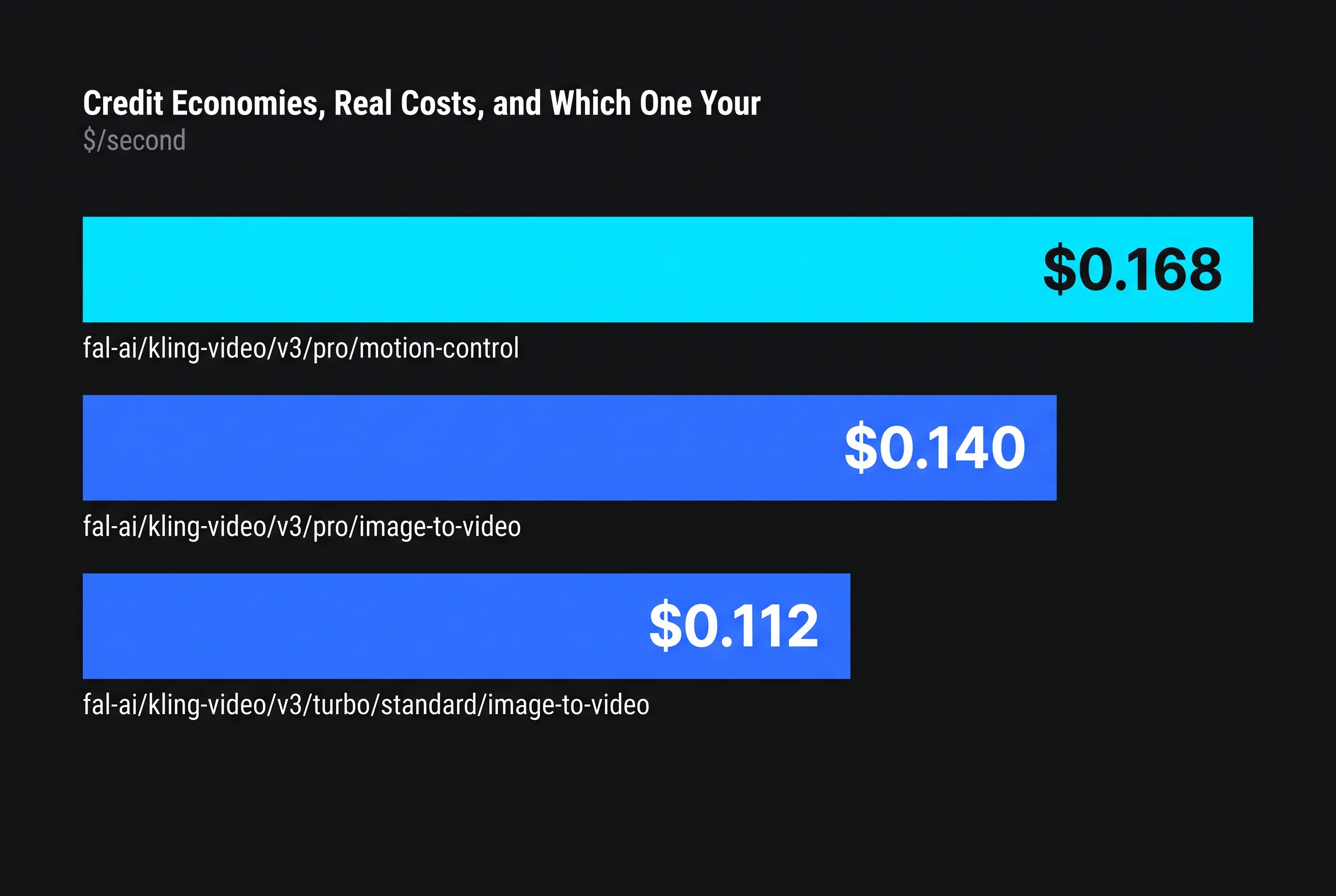
Both are available per-second without a subscription. Kling on fal, re-read live 4 September 2026:
| Endpoint | $/second | 10s |
|---|---|---|
fal-ai/kling-video/v3/turbo/standard/image-to-video | $0.112 | $1.12 |
fal-ai/kling-video/v3/pro/image-to-video | $0.140 | $1.40 |
fal-ai/kling-video/v3/pro/motion-control | $0.168 | $1.68 |
fal-ai/kling-video/v3/4k/image-to-video | $0.420 | $4.20 |
The 4K row is new — a native 4K tier arrived in the late-August 2026 wave, at three times the category rate. Alongside it came a Kling 3.0 Standard image tier priced identically to Pro at $0.140, which is a tier to skip rather than a saving. The autumn round-up covers the rest.
Runway is not on the aggregators, so using it means a direct integration and separate billing.
Which
Runway if video is your craft — multiple shots, continuity, an editing timeline, long takes. Aleph justifies the price on its own for that work.
Kling if you need motion transfer, or if you want frontier quality at the lowest entry price. Also the answer if you would rather pay per second than hold a plan.
For one vertical clip with your face in it, neither creative suite is the right shape of purchase — that is per-clip work, and ours starts at $0.99 for a first 5-second clip. But if you are producing video seriously, these are the two to choose between and the choice is genuinely about which capability you need.