Runway Pricing 2026: Credit Costs Per Model, and What Each Plan Really Buys
Runway's plans look simple until you convert credits into seconds. The per-second credit burn of Gen-4.5, Gen-4 Turbo, Aleph and Act-Two, and how many clips each tier actually holds.
Runway is the closest thing this category has to a professional standard, and its pricing is honest in a way most competitors' is not — the per-model credit rates are published. The work is converting them into clips.
The plans
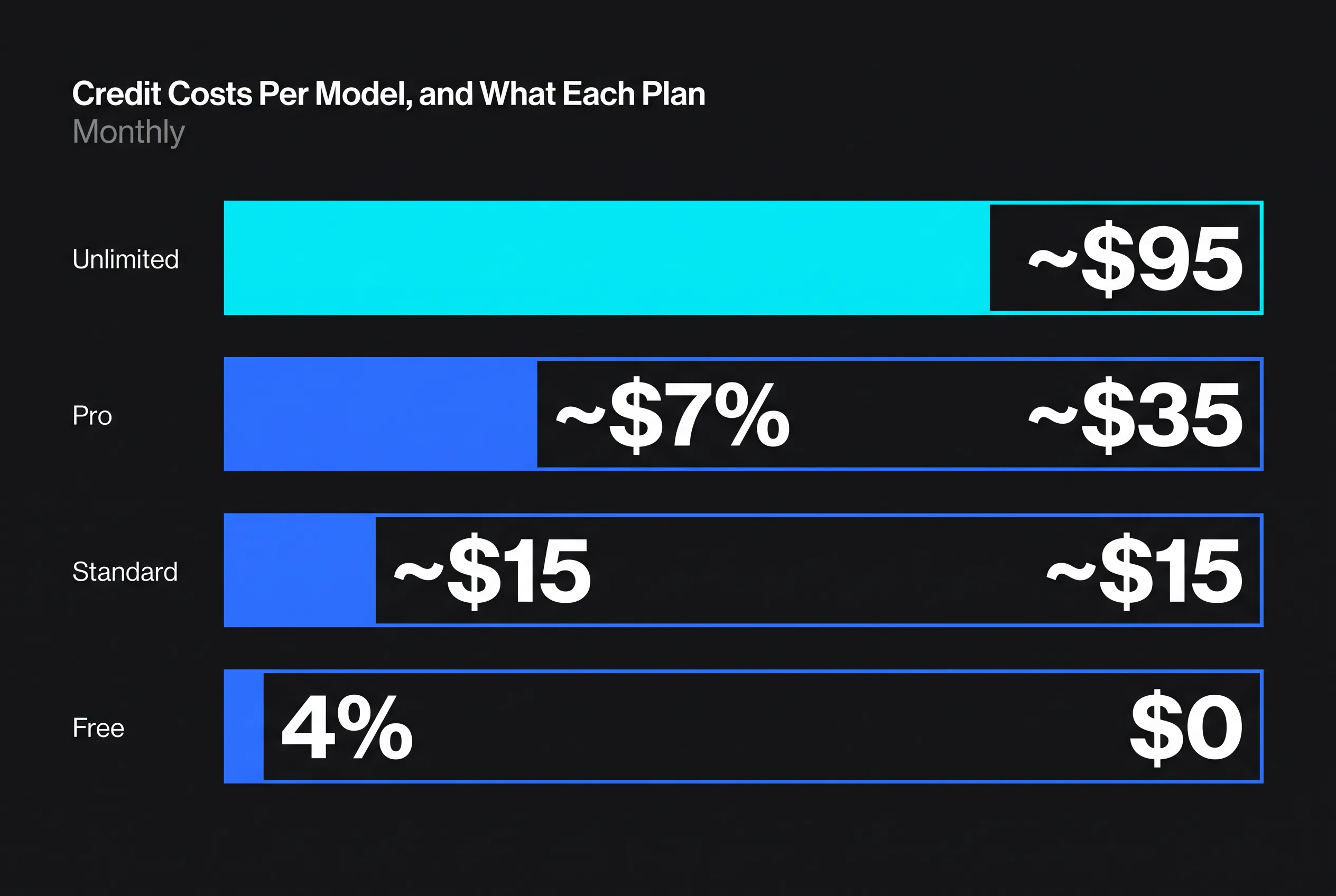
| Plan | Monthly | Annual (per month) | Credits |
|---|---|---|---|
| Free | $0 | — | 125 one-time |
| Standard | $15 | $12 | 625/month |
| Pro | $35 | $28 | 2,250/month |
| Max | $95 | $76 | 9,500/month |
Plan prices and limits below were re-read from the vendor's own pricing page on 18 October 2026. The page lists Standard as watermark-free and expresses allowances in generation time: 625 credits equal 52 seconds of Gen-4.5.
Runway's third-party catalogue (Veo, Seedance, Kling) is Runway's own business arrangement and changes; it says nothing about what those models cost through fal, where Veo is no longer served at all as of October 2026. Whichever models a plan includes, you are buying credits and, at the top, a much bigger pool of them.
Credits to seconds
This is the table that matters:
| Model | Credits/second | 10-second clip |
|---|---|---|
| Gen-4 Turbo | ~5 | ~50 credits |
| Act-Two | ~5 | ~50 credits |
| Gen-4.5 | ~12 | ~120 credits |
| Aleph | ~15 | ~150 credits |
So Standard's 625 credits is about twelve 10-second Gen-4 Turbo clips, or about five on Gen-4.5, or four on Aleph. Pro's 2,250 credits is roughly 45 Turbo clips or 15 on Aleph, and Max's 9,500 is about four times that.
If you plan on the headline credit number rather than the per-model rate, you will run out three times faster than you expected on the good models. That is not a trick — it is just that a 3× quality tier costs 3× the credits.
Where Runway is genuinely ahead
Aleph is the reason to be here. It handles up to 30 seconds at 1080p in a single shot with multi-shot handling and keyframe propagation — aimed at exactly the drift and continuity problems that appear when you stitch short generations together. At roughly $0.28 per second equivalent it is the most expensive option in this space, and for long continuous shots there is not much competing.
Act-Two is performance capture: drive a character with a recorded performance. Distinct from motion transfer, and cheap in credits.
The editor. Runway is a workspace, not an endpoint. If your work involves iteration across many shots, that matters more than any per-second figure.
Where it is not the answer
Runway is not on fal or the other aggregators, so building on it means a separate integration and separate billing. And for the specific job of "put my face into this Reel", the per-second aggregated models are both cheaper and better suited: HappyHorse 1.1 reference-to-video at $0.14/second (720p), or Kling 3.0 Pro Motion Control at $0.168/second, both read live on 2 August 2026.
Honestly
If you are producing video as craft — multiple shots, continuity, an editing timeline — Runway at Pro is a fair price for a serious tool and the credit maths works out once you plan per model.
If you want one vertical clip with your face in it, a full creative suite is the wrong shape of purchase. That is the gap we fill, and our entry is a 3-day trial for $4.99 (one 15-second video) that becomes a $39/month plan unless you cancel. Different products, and Runway is not overpriced for what it is.
How to do this without code: If you want one vertical clip with your face rather than a creative suite, a per-clip route is the other shape of purchase. In AutoHustle this is the autopilot: paste the Reel link, add one photo of yourself and confirm the plan (about 4 credits per second of finished video, so 60 credits for a full 15-second call; analysing the Reel is free). See How to put your face in any Reel and Recreate an Instagram Reel.
Related reading: AI Video Without a Subscription: What Per-Clip Pricing Actually Costs · Runway vs Kling: Credit Economies, Real Costs, and Which One Your Job Needs