AI Face Swap Tools Compared 2026: The $15 Tier vs the $99 Tier
The face-swap market split into a cheap paste-a-link tier and an expensive full-replacement tier with nothing in between. What each actually does technically, and which one your clip needs.
Search "AI face swap video" in 2026 and you get two clusters of products that are described with the same words and do fundamentally different things. Knowing which cluster you are looking at explains almost every disappointing result people report.
The two tiers
The $5–15 tier — SwapTok, ReelFaceSwap and a long tail of clones. You paste a link or upload a clip, and an inswapper-class model composites your face onto the existing performer. Typically 720p, usually capped around 15 seconds, often with a watermark on the free path. It is fast, it is cheap, and the body, hair, wardrobe and build all remain those of the original person.
The $49–220 tier — Higgsfield Recast and comparable products. These do full character replacement: the person is regenerated, not composited, so body proportions and clothing follow your reference rather than the source performer. The results hold up at a size where the cheap tier does not. The workflow is manual — upload a source clip, upload a character, configure, wait.
There is essentially nothing in the middle, which is the interesting part of this market.
When the cheap tier is genuinely fine
Face-only compositing works when the head stays roughly frontal, the clip is short, and the body is not the point — talking heads, reaction shots, memes. It fails visibly the moment the head turns past three-quarters, the lighting changes, or the body does something a viewer would notice belongs to someone else. Dance clips are the worst case: exactly when the motion gets interesting, the seam shows.
What full replacement costs at the model level
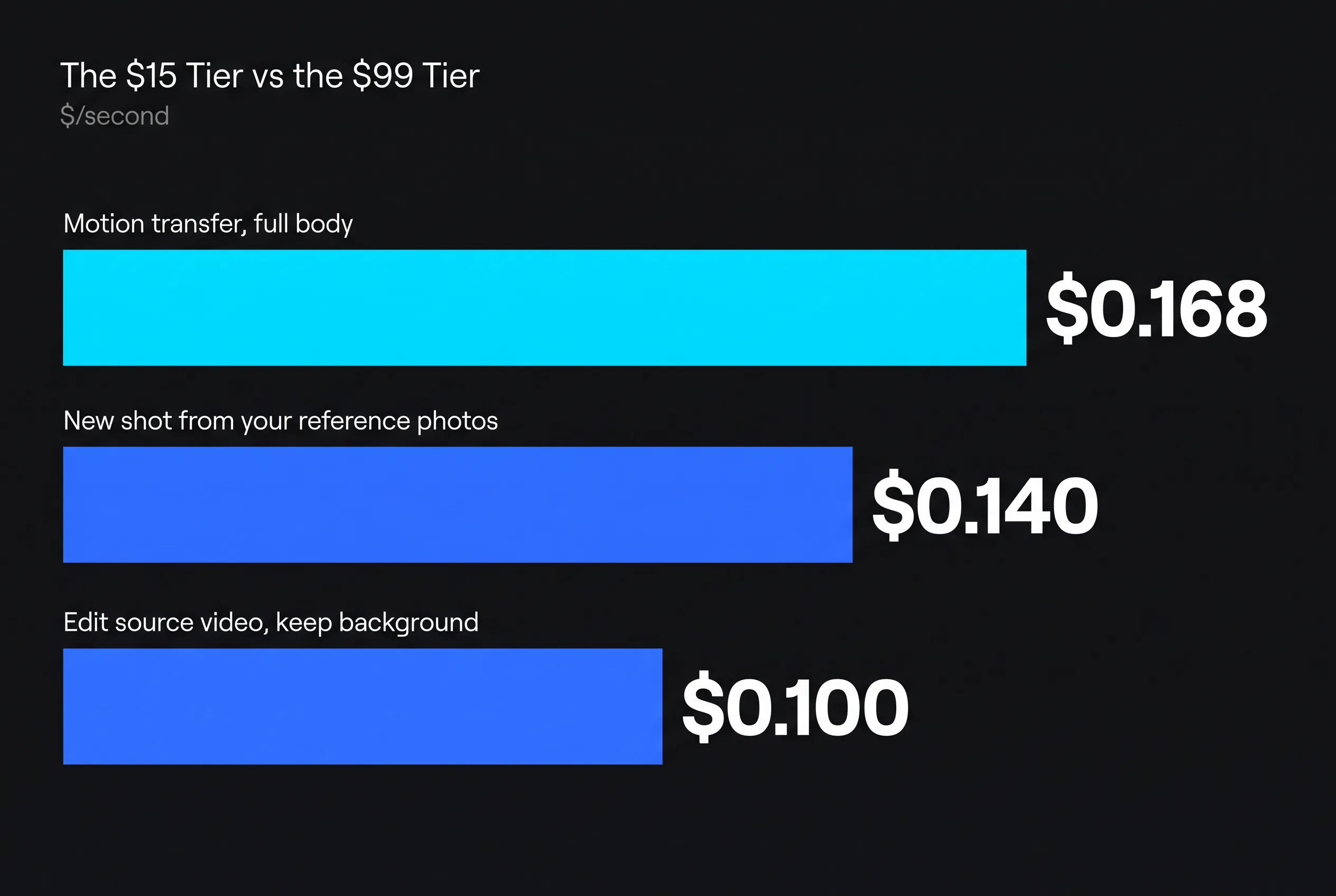
If you go direct to the models rather than through a consumer product, prices as of 2 August 2026:
| Job | Endpoint | $/second | 10s clip |
|---|---|---|---|
| Motion transfer, full body | fal-ai/kling-video/v3/pro/motion-control | $0.168 | $1.68 |
| Edit source video, keep background | fal-ai/wan/v2.7/edit-video | $0.100 | $1.00 |
| New shot from your reference photos | alibaba/happy-horse/v1.1/reference-to-video | $0.140 | $1.40 |
A ten-second full-replacement clip costs between $1.00 and $1.68 in compute. Consumer products in the top tier charge $49–99 a month for a credit pool that buys a handful of those. That gap is the product's convenience margin, and whether it is worth paying depends entirely on whether you want to learn three model schemas.
Higgsfield-tier pricing, with a caveat
Higgsfield's published tiers as of mid-2026 are reported around $15 Starter, $34–39 Plus and $84–99 Ultra, with top-up credit packs around $5 per 100 credits that expire after 90 days. Different models consume very different credit amounts per generation, and that rate is not prominently published. Treat any specific number as needing verification on their own pricing page — the tier structure has been revised repeatedly this year.
What we would tell a creator
If your clip is a short frontal talking head and you need it today, the cheap tier is honestly adequate. If the body moves, if the clip will be judged at full screen, or if the wardrobe matters, face-only compositing will not get there and no amount of retrying changes that — it is an architectural limit, not a quality setting.
The third option is a workflow that reads your clip and routes it to the right model automatically, which is the gap the market has not filled: paste-a-link convenience with full-replacement quality behind it.