Krea vs Higgsfield: Two Ways to Buy a Catalogue of Models
Both sell access to many models behind one interface, priced in units you cannot convert to clips. Where they differ on entry price, video access, credit expiry and what each is actually built for.
These two get compared constantly because they occupy the same shelf: a subscription that buys you many models rather than one. The differences that matter are not in the model lists, which overlap heavily, but in pricing structure and in who each was built for.
Price structure side by side
| Krea | Higgsfield | |
|---|---|---|
| Entry | $9/month (Basic) | ~$15/month (Starter) |
| Mid | $35/month (Pro) | ~$34–39/month (Plus) |
| Upper | $105/month (Max) | ~$84–99/month (Ultra) |
| Team | $200/month, up to 50 seats | ~$49/seat (Business) |
| Free tier | 100 units per day, refilled | limited |
| Rollover | none on individual plans | top-ups expire ~90 days |
Higgsfield's tier figures vary across sources, which usually means they changed recently — the company has revised what its tiers include more than once this year. Verify on the pricing page.
The two things that actually differ
Krea's free tier refills daily. 100 compute units every day, no card. That is a fundamentally different mechanic from a one-time grant: it lets you learn a tool over weeks rather than in one sitting, and it is the single strongest argument for starting with Krea if you are still deciding what you need.
Higgsfield's Recast does full-body character replacement — the person is regenerated rather than composited, so build and wardrobe follow your reference. That is a genuinely differentiated capability at this price point, and it is what the higher tiers are for.
The entry-price trap on Krea
Basic at $9 is described as having limited video. Full access to the video model set arrives at Pro, $35. If video is why you are shopping, Krea's real entry price is $35, not $9 — and at that point the comparison against Higgsfield's Plus tier is much closer than the headline numbers suggest.
What neither solves
Both are manual: you upload, you choose, you configure, every time. Neither ingests a link. Neither watches anything and produces content without you. If your actual workflow is "I saw this Reel and want my version", both make you do the two-upload dance on every clip.
And both price in units that do not convert to a published number of clips. Different models consume very differently, the rate is not prominently displayed, and you discover your real capacity by spending. That criticism applies to the whole category, not to either company specifically.
The per-second floor
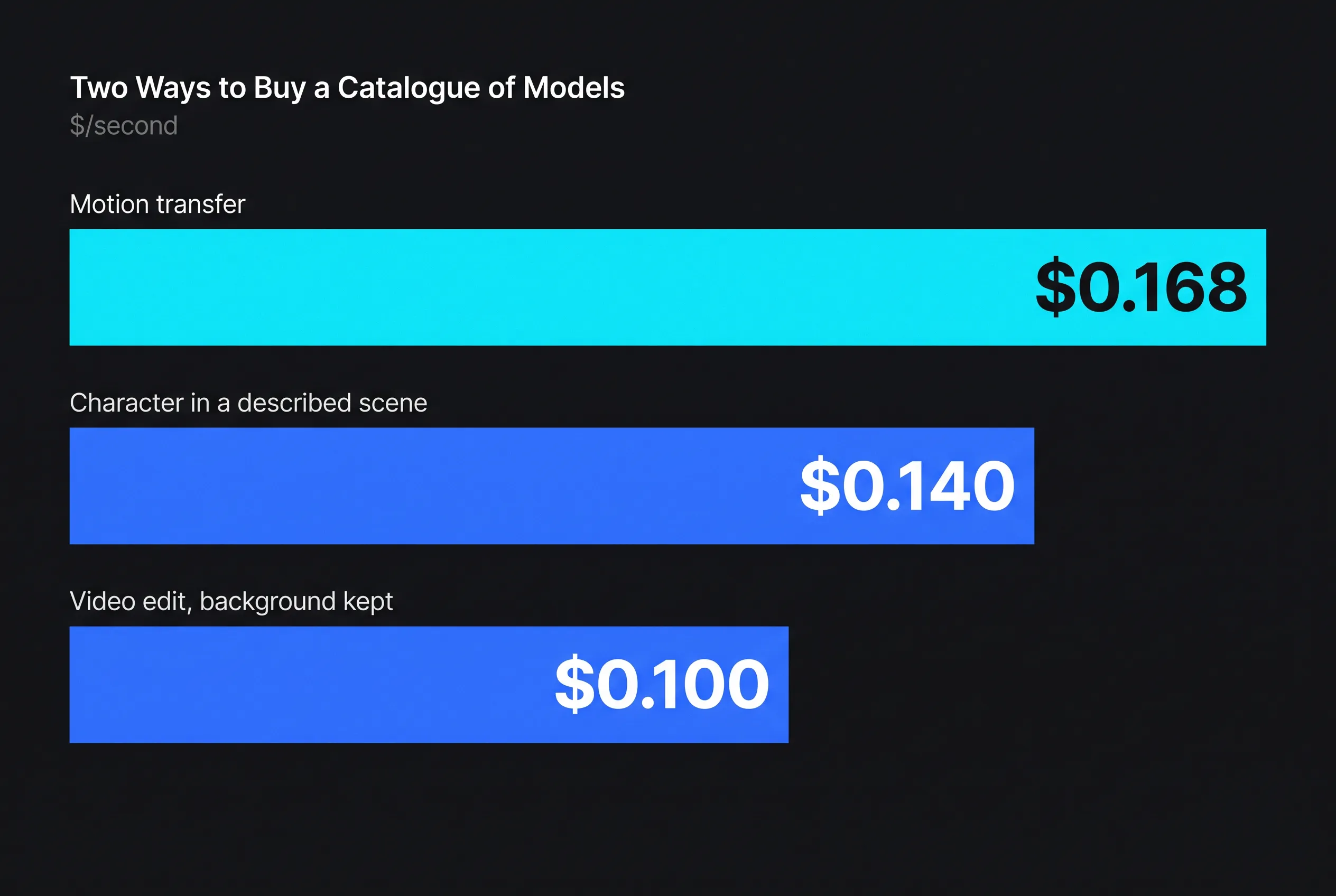
For reference, the models underneath. Prices read live from fal.ai on 2 August 2026:
| Job | Endpoint | $/second | 10s |
|---|---|---|---|
| Character in a described scene | alibaba/happy-horse/v1.1/reference-to-video | $0.140 | $1.40 |
| Motion transfer | fal-ai/kling-video/v3/pro/motion-control | $0.168 | $1.68 |
| Video edit, background kept | fal-ai/wan/v2.7/edit-video | $0.100 | $1.00 |
$35 of subscription is roughly 20–30 clips at model cost. Both products are fairly priced if you use the breadth; both are poor value if you always run the same job.
Which to pick
Krea if you are exploring, working across image and video, and want to learn before committing. The daily free refill makes this decision nearly free.
Higgsfield if you specifically need full-body character replacement and are producing enough to justify a plan. Its catalogue is broader and its top tier does something Krea's does not.
Neither if you want one specific clip a few times a month. Then per-clip pricing is the right shape — ours starts at $0.99 for a first 5-second clip — but if you are genuinely model-shopping, Krea's free units beat anyone's paid first clip.