How Much Does a 30-Second AI Video Cost in 2026?
The honest arithmetic: raw model cost for 30 seconds, why nobody generates 30 seconds in one shot, and the retry multiplier that dominates the real number.
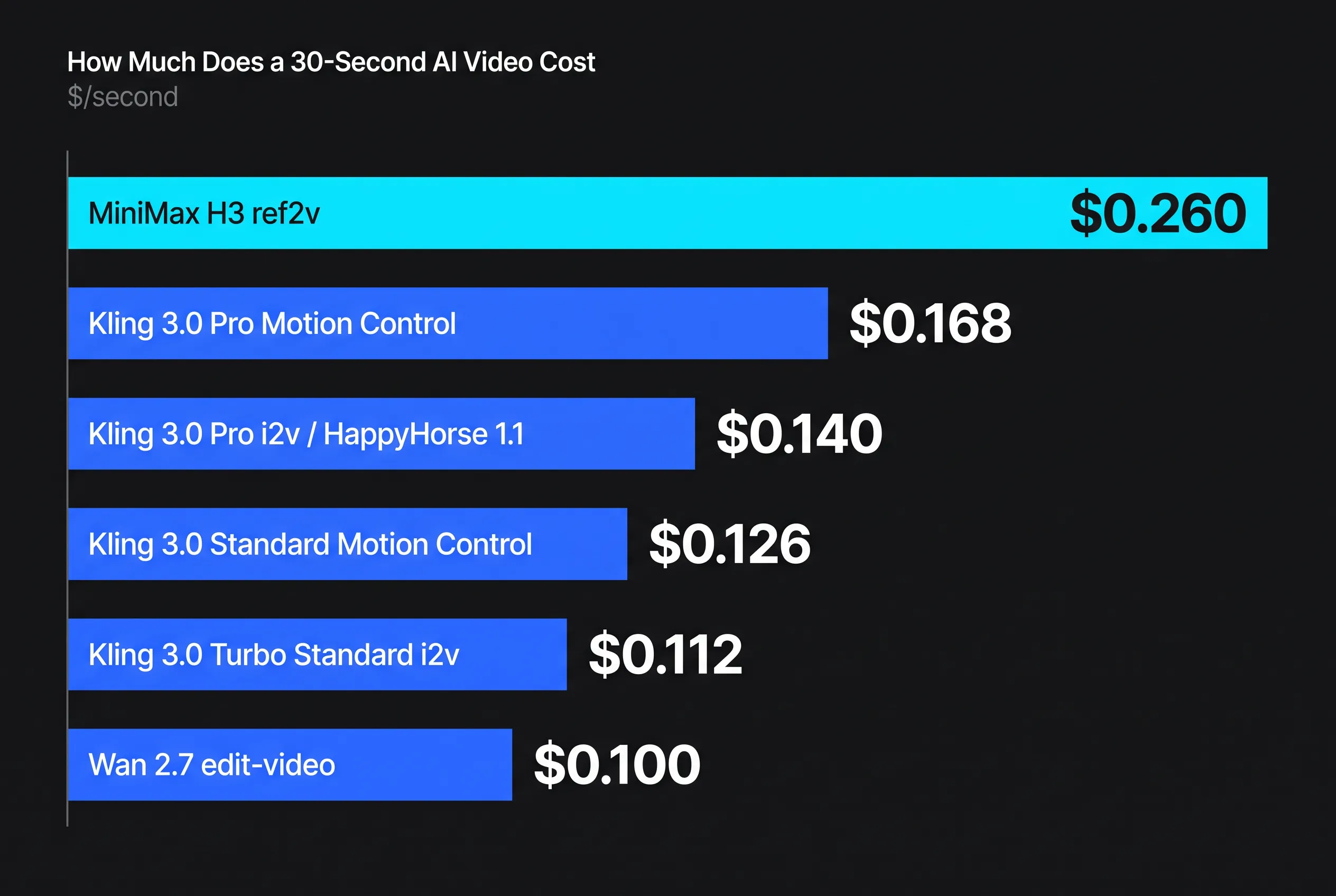
The naive answer is thirty times the per-second rate. The useful answer accounts for the fact that nobody generates thirty seconds in one call, and that your real cost is driven by retries rather than by the price list.
The raw numbers
Per-second prices re-read live from the fal.ai endpoints on 4 September 2026:
| Model | $/second | 30 seconds |
|---|---|---|
| Wan 3.0 Prime i2v | $0.050 | $1.50 |
| FLUX.3 t2v | $0.085 | $2.55 |
| Wan 2.7 edit-video | $0.100 | $3.00 |
| Kling 3.0 Turbo Standard i2v | $0.112 | $3.36 |
| Kling AI Avatar v2 Pro | $0.115 | $3.45 |
| Kling 3.0 Standard Motion Control | $0.126 | $3.78 |
| Kling 3.0 Pro i2v / HappyHorse 1.1 | $0.140 | $4.20 |
| OmniHuman 1.5 | $0.160 | $4.80 |
| Kling 3.0 Pro Motion Control | $0.168 | $5.04 |
| MiniMax H3 ref2v | $0.260 | $7.80 |
| Seedance 2.5 (720p24) | ≈ $0.462 | ≈ $13.90 |
So: $3 to $5 for thirty seconds on anything sensible, under $2 if there is no person in frame, and $13.90 at the top of the range.
Why that number is fictional
Most models cap output well below thirty seconds — commonly 10 or 15 — and even where thirty is available, identity drift compounds with duration. A single thirty-second shot with a person in it will look worse at the end than at the start.
Seedance 2.5, released in late August 2026, is the first endpoint to offer a genuine 30-second single take. It also inherits the family's refusal of real human likenesses, so the duration record belongs to footage with nobody in it — which is the one case where drift was never the problem.
In practice a thirty-second piece is four to six shots of five to eight seconds each, cut together. Same total seconds, same total cost, much better output. The arithmetic does not change; the quality does.
The multiplier that actually decides your bill
Retries. A first attempt at a new kind of clip fails or disappoints often enough that a realistic budget is two to three times the raw cost. That puts a finished thirty-second piece at roughly $8–15 in compute for someone who knows what they are doing, and considerably more for a first attempt at an unfamiliar format.
The retry rate is dominated by one thing: whether the right family of model was chosen. Asking a reference-to-video model to copy a specific choreography produces a plausible clip that is not the clip you wanted, every time, at full price. That is not a quality failure, it is a routing failure, and it is the most expensive mistake available.
Three cost traps
Credit platforms scale with quality, APIs mostly do not. The per-second rates above are flat regardless of resolution. On a credit subscription they are not: a Kling 3.0 clip runs about 6 credits per second at 720p without audio and about 12 at 1080p with native audio. Same clip, double the burn, on two toggles that show no price.
Endpoints with no published price. Some models have no per-output rate in fal's pricing API at all — asked, it returns the platform's GPU-fallback rate, which is what it answers for anything missing from its pricing table. Wan 2.2 Animate Replace was the original example; the August 2026 wave added MiniMax H3 Max, Gemini Omni Flash 1.1, the full Wan 3.0 tier, LTX 2.5 and Grok Imagine 1.5. Anyone building on them quotes a worst-case ceiling ($0.10–0.35 per job, in our registry) rather than a price, and finds out the real cost after the run.
Expiring credits. Consumer plans increasingly expire top-up credits after 90 days. Bursty usage means paying for capacity you never spend.
What that buys you elsewhere
A UGC creator averages around $198 per deliverable in 2026 — down sharply year on year, but still two orders of magnitude above generating a clip. A five-variation campaign runs roughly $1,100–2,950 with human creators against $100–285 with AI tooling.
The comparison is not entirely fair, because a human creator brings a face an audience trusts and a room the model has never seen. But for testing which hook works before committing, the arithmetic is not close.