AI Video Without a Subscription: What Per-Clip Pricing Actually Costs
Most AI video is sold as a monthly plan with credits that expire. The per-second alternative, the volume at which each wins, and how to work out which side of the line you are on.
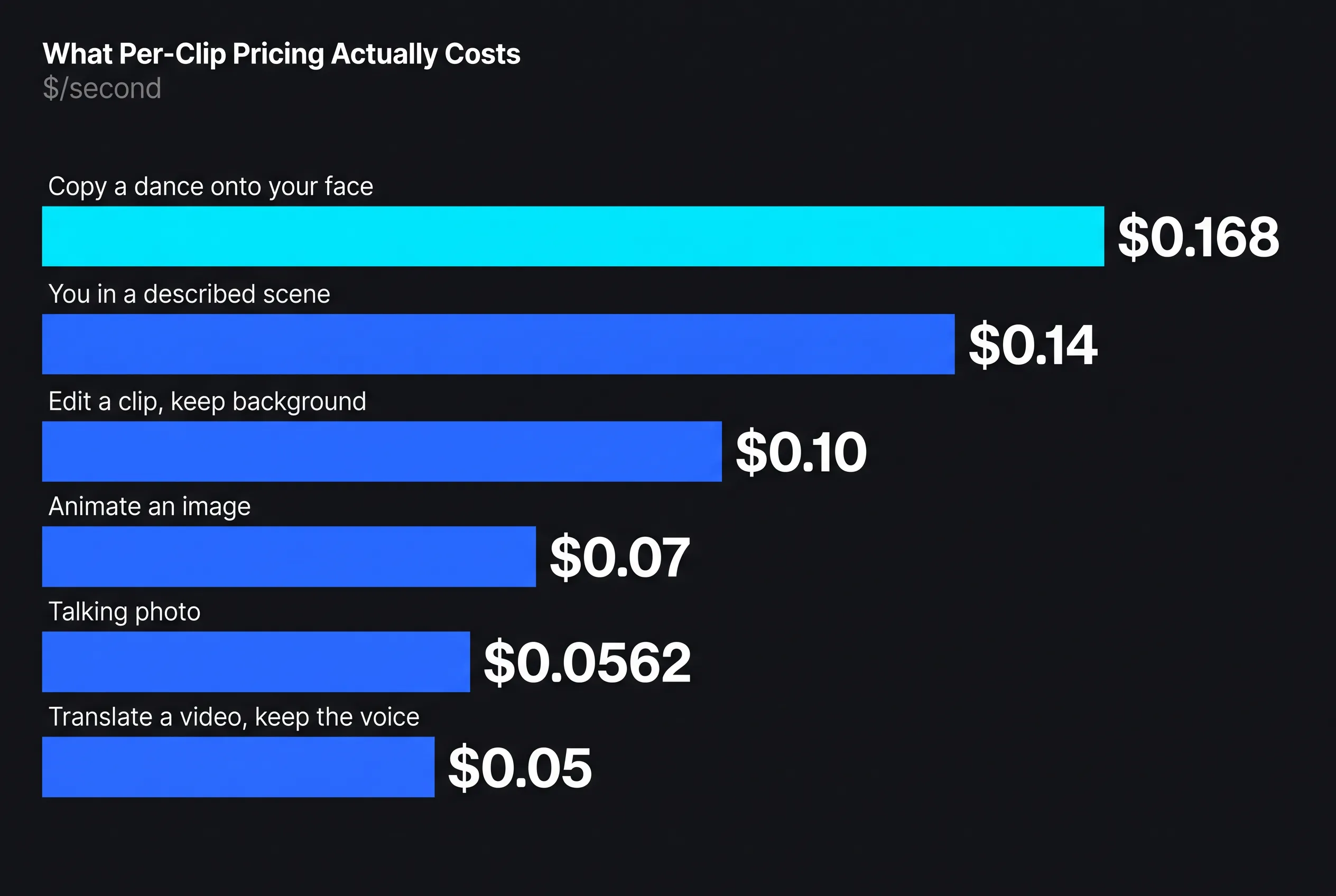
Nearly every consumer AI video tool is a subscription with a credit pool. That is a good deal at high volume and a poor one at low volume, and the crossover is easy to calculate once you know the per-second rate.
The per-second floor
Prices checked against the live endpoints on 3 August 2026.
| Job | Model | $/second | 10s clip |
|---|---|---|---|
| Animate an image | Kling 2.6 Pro | $0.07 | $0.70 |
| Animate an image | LTX 2.3 Pro | $0.08 | $0.80 |
| Talking photo | Kling AI Avatar v2 Standard | $0.0562 | $0.56 |
| Edit a clip, keep background | Wan 2.7 Edit Video | $0.10 | $1.00 |
| You in a described scene | HappyHorse 1.1 Reference to Video | $0.14 | $1.40 |
| Copy a dance onto your face | Kling 3.0 Pro Motion Control | $0.168 | $1.68 |
| Translate a video, keep the voice | HeyGen v2 Translate | $0.05 | $3.00/min |
So a finished ten-second clip is $0.56 to $1.68 in compute, depending on the job.
The crossover
Take the subscription price and divide by your per-clip cost.
- A $15 plan is worth about 15–20 ten-second clips at $0.70–1.00.
- A $29 plan is about 30–40.
- A $99 plan is about 100–140.
If you produce more than that, the plan wins — and you also get an editor, templates and an interface, which are worth something real.
If you produce less, you are pre-paying for capacity. Add two common terms that make it worse: credits that do not roll over, and top-up packs that expire after 90 days. Bursty usage loses a meaningful share of what it buys.
The three questions that decide it
1. How many clips did you actually publish last month? Not planned — published. Most people overestimate by a factor of two or three when choosing a plan.
2. Is your usage steady or bursty? A campaign every two months is the worst possible fit for a monthly credit pool.
3. Do you need the editor? If you are also cutting, captioning and scheduling, a subscription that includes those is not competing with a raw endpoint at all.
The trap in credit plans
A credit is not a unit of video. Consumption varies by model, tier, resolution and audio — on one major consumer plan the same clip runs about 6 credits per second at 720p without audio and about 12 at 1080p with it. Two toggles, double the burn, and the rate is rarely displayed next to the toggles.
That is why a "1,000 credit" plan can be 15 clips or 100. You find out by spending, which is precisely what per-second pricing removes.
Where we sit
We are the per-clip side of this comparison and we will not pretend otherwise: if you generate every day, a subscription somewhere will beat paying per clip, including ours. Our first video — a 5-second clip — is $0.99 and there is no plan to hold, which is the right shape for occasional and bursty use — and for finding out whether the output is any good before committing to a month of anything.
Every model in our catalogue shows its per-second price on its own page, so the arithmetic above is checkable rather than promised.