Krea AI Pricing 2026: Compute Units, Six Tiers, and the Daily Free Refill
Krea sells compute units across six plans from free to $200. What a unit buys, why the daily free refill is unusually generous, and the tier where video actually unlocks.
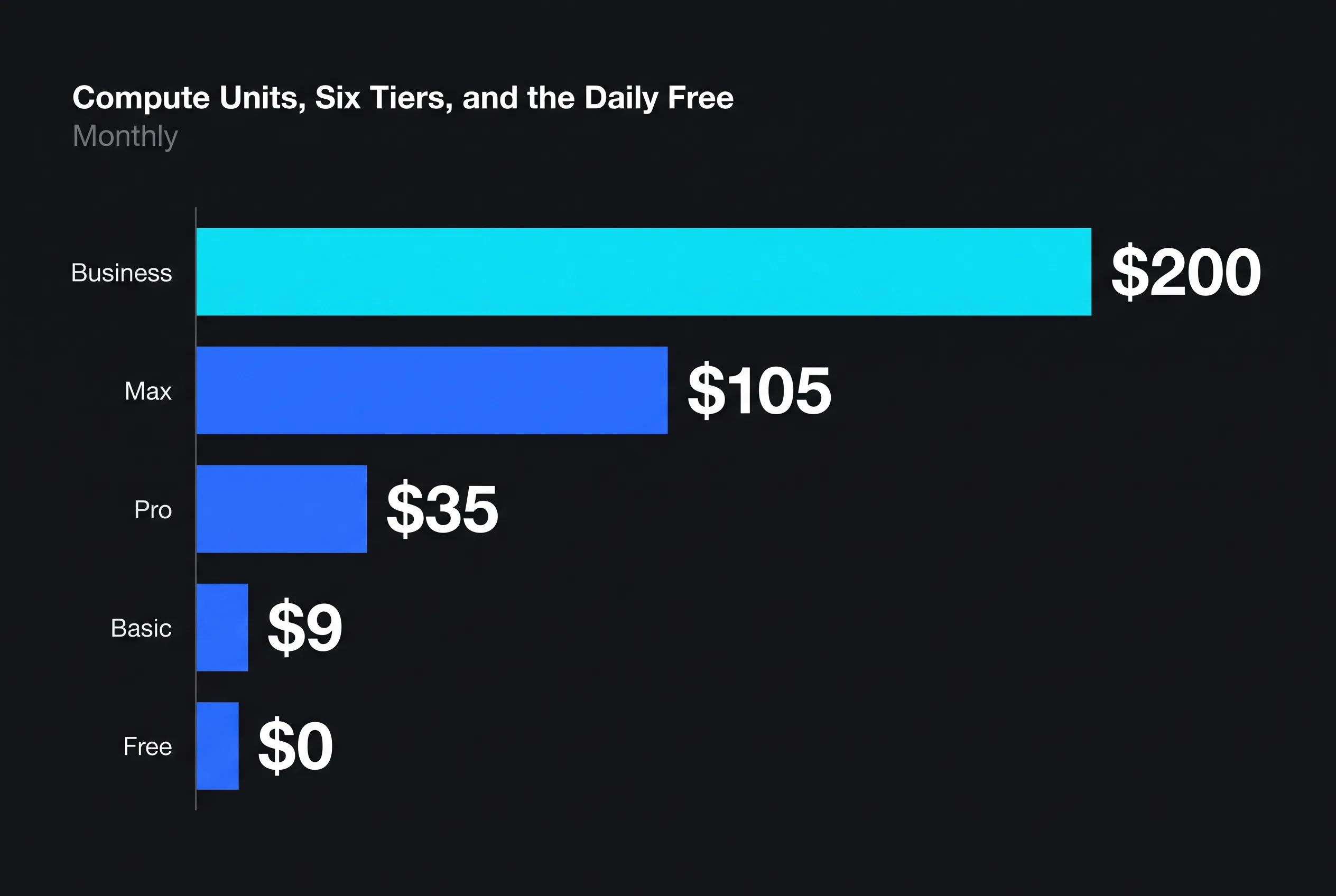
Krea's proposition is breadth: one interface over a large catalogue of image and video models, sold as compute units rather than per-model credits. That makes it excellent for exploration and slightly awkward to budget.
The tiers
| Plan | Monthly | Units | Notes |
|---|---|---|---|
| Free | $0 | 100/day | refilled daily, no card |
| Basic | $9 | 5,000/month | commercial licence, limited video |
| Pro | $35 | 20,000/month | all video models, Nodes, LoRA |
| Max | $105 | 60,000/month | high-resolution upscaling |
| Business | $200 | 80,000/month | up to 50 seats |
| Enterprise | custom | — | — |
Annual billing is reported at around 40% off consumer plans and 20% off Business.
Two structural details. Units do not roll over on individual plans — only Business and Enterprise credits carry forward. And the free tier refills daily rather than monthly, which is a meaningfully different retention mechanic: 100 units every day beats a one-time grant for actually learning a tool.
The tier that matters is Pro
Basic at $9 is described as having limited video. Full access to the video model set — reported to include Veo 3.1, Kling, Hailuo, Wan and Runway — arrives at Pro, $35, along with Nodes for workflow automation and LoRA training.
If video is why you are looking at Krea, the entry price is $35, not $9. Budgeting on the headline number is the common mistake here.
What breadth buys and what it costs
The upside is real: one subscription, many models, no separate accounts, and a fast path to comparing outputs side by side. For someone still deciding which model suits their work, that is worth more than a per-second saving.
The cost is that a compute unit is not a fixed quantity of output. Different models consume very differently, and a plan sized in units does not tell you how many clips you get. You find out by spending, which is the same structural criticism that applies to every credit-based tool in this category.
Where the API sits
If you already know which model you want, going direct is cheaper and priced in a unit you can reason about. Per-second prices read live on 2 August 2026:
| Job | Endpoint | $/second | 10s |
|---|---|---|---|
| Animate a photo | alibaba/happy-horse/v1.1/image-to-video | $0.140 | $1.40 |
| You in a described scene | alibaba/happy-horse/v1.1/reference-to-video | $0.140 | $1.40 |
| Copy a dance onto your face | fal-ai/kling-video/v3/pro/motion-control | $0.168 | $1.68 |
$35 of Krea Pro is roughly 20–25 clips at those model rates — so the subscription is fair value if you use the breadth, and expensive if you always reach for the same model.
Who it suits
Yes: you are exploring, you work across image and video, you value one interface over many, and the daily free refill lets you try before committing.
Not really: you know exactly which model you need and you need it a few times a month. Then you are paying for a catalogue you do not open.
For that second case per-clip pricing is the honest structure — ours starts at $0.99 for a first 5-second clip — but if you are genuinely model-shopping, Krea's free daily units are a better place to start than anyone's paid first clip.