The Cheapest Way to Make UGC Videos in 2026 (With Real Numbers)
Human creators average around $198 a deliverable and AI clips cost a few dollars. The full arithmetic across four production routes, and the places where the cheap route quietly stops working.
UGC-style video is now the default creative format for small e-commerce, and its economics changed sharply in the last year. Here is what each production route costs, in order.
The four routes
Hire a creator. Rates run $75–300 for beginners, $300–1,000 mid-tier, and $600–3,000+ at the top. Market average sits around $198 per deliverable — down roughly 44% year on year, driven by more creator supply and by AI competition. Extended usage rights for paid ads typically add 30–50% on top of the base rate.
Film it yourself. Free in cash, expensive in hours, and constrained by the fact that you have one face, one room and one wardrobe. Fine for one product, hard to scale to variations.
AI UGC platforms. Purpose-built tools sell finished ad clips in the range of roughly $1–5 each.
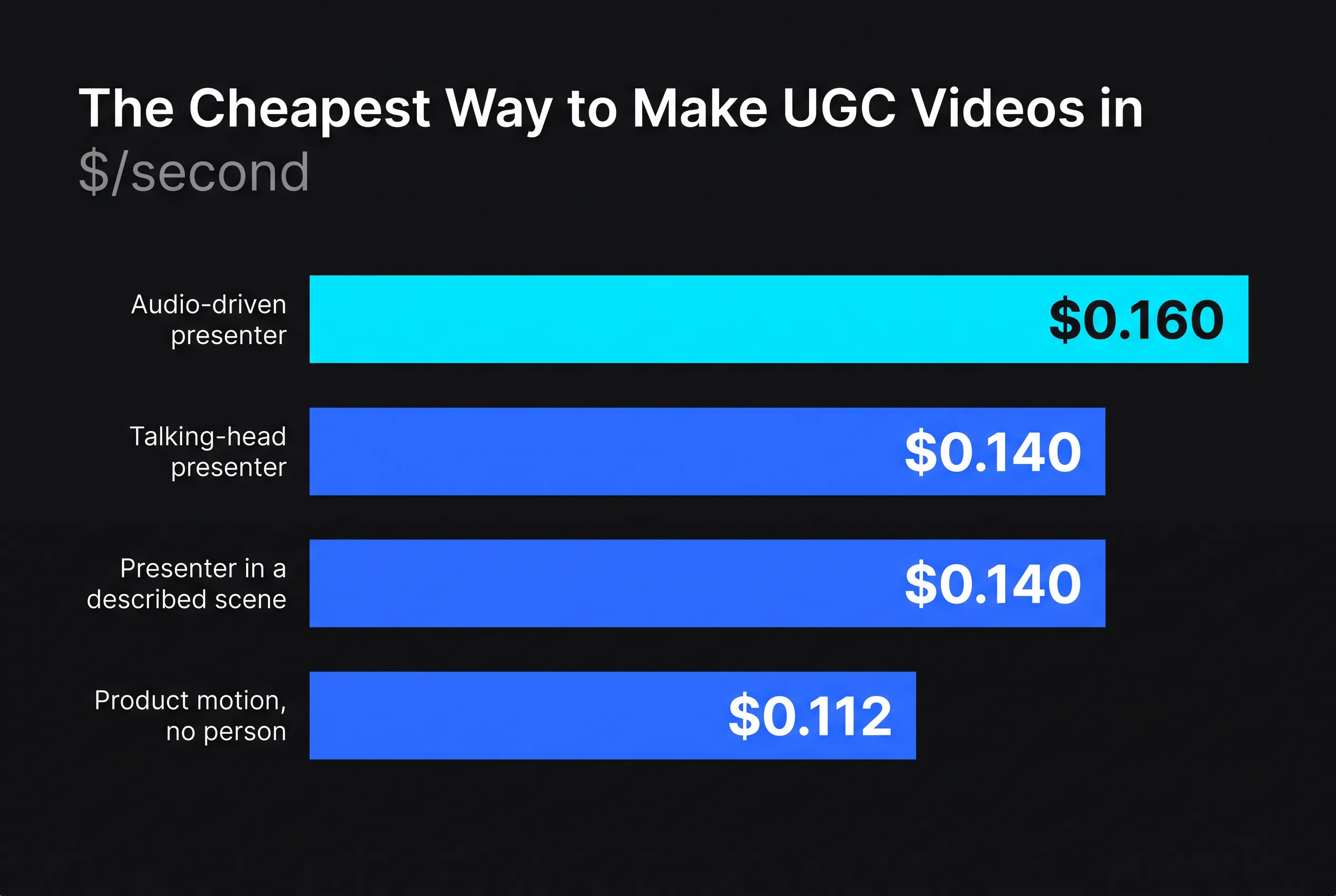
Go direct to the models. Per-second API pricing, read live on 2 August 2026:
| Job | Endpoint | $/second | 10s clip |
|---|---|---|---|
| Talking-head presenter | alibaba/happy-horse/v1.1/image-to-video | $0.140 | $1.40 |
| Presenter in a described scene | alibaba/happy-horse/v1.1/reference-to-video | $0.140 | $1.40 |
| Audio-driven presenter | fal-ai/bytedance/omnihuman/v1.5 | $0.160 | $1.60 |
| Product motion, no person | fal-ai/kling-video/v3/turbo/standard/image-to-video | $0.112 | $1.12 |
Where the gap really shows
Not on one video — on variations. A single campaign with five creative variants runs roughly $1,100–2,950 with human creators against $100–285 with AI tooling. At model cost the same five ten-second clips are about $7.
Since the entire logic of UGC advertising is testing many hooks to find the one that works, cost-per-variation is the number that matters, and it is where the routes separate by two orders of magnitude.
Where the cheap route stops working
Trust-sensitive categories. Supplements, finance, anything health-adjacent. Audiences and platforms both scrutinise these harder, and a synthetic presenter is a liability rather than an efficiency.
Bottom of funnel. A real person who used the product and says something specific outperforms a generated presenter reading copy. Generated clips are strongest at the top, where you are buying attention and testing hooks.
Disclosure. Meta requires disclosure of AI-generated content in ads, and enforcement can reach retroactively into a running campaign. Budget for the label; do not budget for hiding it.
A face that is not yours. Using a real person's likeness without consent is not a cost saving, it is a takedown waiting to happen. Several models refuse real likenesses at the API level for this reason.
What we would actually do
Test hooks with generated clips, because ten variations for the price of a coffee lets you find the winner empirically. Then put budget behind a human creator for the one that won, where authenticity earns its premium at the bottom of the funnel.
The mistake in both directions is treating this as an either/or. Paying $198 a piece to find out which of ten hooks works is burning money; putting a synthetic presenter in front of a high-intent audience is leaving conversion on the table.