Kling AI Pricing 2026: Five Tiers, Credit Math, and the API Alternative
Kling's consumer plans run $6.99 to $127.99 a month with credits that expire monthly. What a clip actually costs in credits, where the renewal price differs from the advertised one, and when the API is cheaper.
Kling is the model behind a large share of the character and motion work being done in 2026, and it is sold two ways: a consumer subscription with credits, and per-second API access. The two prices are very different, and which one is right depends almost entirely on volume.
The subscription tiers
| Plan | Monthly | Yearly (per month) |
|---|---|---|
| Free | $0 — 66 daily credits, expire in 24h | — |
| Standard | $6.99 first month, ~$8.80 renewal | ~$6.60 |
| Pro | $25.99 | ~$24.42 |
| Premier | $64.99 | ~$60.72 |
| Ultra | $127.99 | no annual option |
Two things in that table are easy to miss. The Standard headline price is a first-period rate — renewal is higher, and the "up to 30% off" promotions on each plan also apply only to the first billing period. And Ultra has no annual discount as of mid-2026, while annual billing saves around a third on the three tiers below it.
Subscription credits expire at the end of each billing month. They do not roll over.
What a clip costs in credits
Kling 3.0 consumes roughly 6 credits per second at 720p without audio, rising to about 12 credits per second at 1080p with native audio. So the same ten-second clip is 60 credits or 120 credits depending on two toggles most people flip without thinking about it.
That doubling is the single most useful fact about Kling's credit economy. Prove a shot at 720p, render the keeper at 1080p, and your effective plan size doubles.
The API alternative
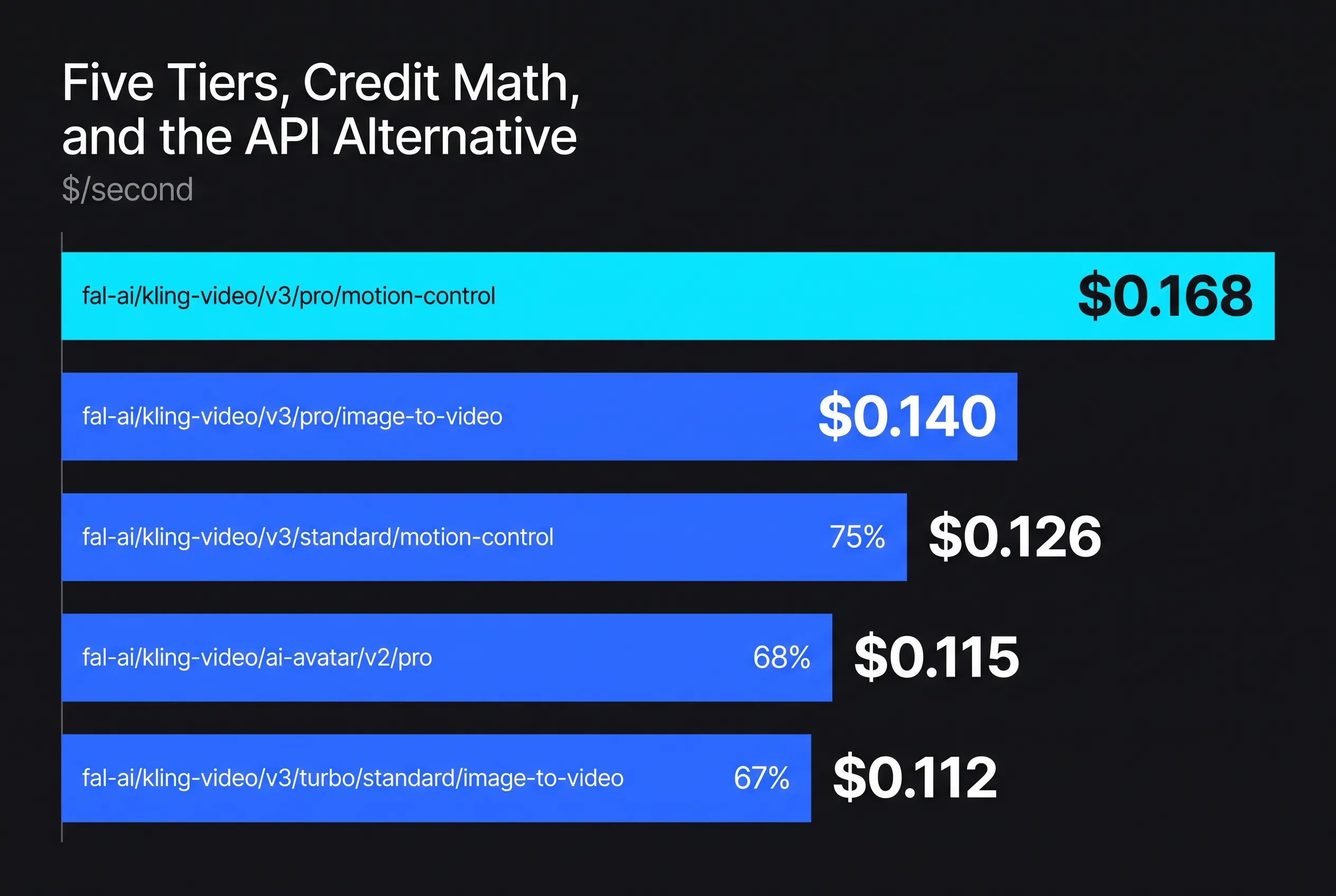
Per-second prices re-read live from the fal.ai endpoints on 4 September 2026:
| Model | $/second | 10s clip |
|---|---|---|
| Kling 3.0 Turbo Standard image-to-video | $0.112 | $1.12 |
| Kling 3.0 Standard Motion Control | $0.126 | $1.26 |
| Kling 3.0 Standard image-to-video | $0.140 | $1.40 |
| Kling 3.0 Pro image-to-video | $0.140 | $1.40 |
| Kling 3.0 Pro Motion Control | $0.168 | $1.68 |
| Kling Native 4K image-to-video | $0.420 | $4.20 |
| Kling AI Avatar v2 Pro | $0.115 | $1.15 |
No credits, no expiry, no renewal-rate surprise. A useful detail: failed motion-control jobs are auto-refunded, so a policy rejection costs nothing.
Two September additions are worth reading carefully. The Standard image-to-video tier arrived at $0.140 — the same rate as Pro, for less model. There is no job where it is the right pick; if you want to spend less, the Turbo Standard row at $0.112 is the one. And the Native 4K tier is $0.420, three times the category rate; it is a delivery-format decision, not a quality upgrade for a vertical clip watched on a phone.
Who each route suits
The subscription if you generate often and want the web interface, the model picker and the iteration loop without writing code. At Pro ($25.99) you are buying roughly 15–30 ten-second clips a month depending on your resolution and audio settings — which is good value at daily use and poor value at four clips.
The API if your usage is bursty, if you need a predictable per-clip cost, or if you are putting Kling behind something else. Ten clips a month is about $14 and nothing in a quiet month.
The free tier for evaluating whether the model does what you need. 66 daily credits is roughly one short 720p clip a day, which is enough to answer that question.
Where we sit
We route to these same Kling endpoints and pay these same per-second prices, and our entry is a 3-day trial for $4.99 (one 15-second video) that becomes a $39/month plan unless you cancel; one-off credit packs work without any plan. That is the honest comparison: if you generate daily, a Kling subscription will beat paying per clip anywhere, including with us. If you want one specific Reel recreated without learning character_orientation, per-clip is the sane way to buy it.
October 2026 update
Prices read on 18 October 2026: Kling O3 video edit is $0.14 per second on both Pro and Standard (the 4K edit is $0.42), Kling 3.0 Turbo Standard image-to-video is $0.112, Kling AI Avatar v2 Pro $0.115 and Standard $0.0562. fal describes the O3 editor, upgraded (reportedly in June) to take 3–15 second inputs, as its preferred secondary option for editing existing footage, which makes it the main alternative to HappyHorse for replacing a person in a clip (guide). We had rejected an earlier version of that editor in April for outfit and hair drift, so it is on our retest list, not our routing table. The subscription tiers above are as reported in mid-2026 and were not re-checked.
How to do this without code: Copying a dance with Kling Motion Control does not need a Kling account or an API key. In AutoHustle this is the Dance copy tool: upload the reference clip and one full-body photo (3 credits per second with a 24-credit minimum, quoted before you press Generate). See How to make an AI dance video and AI dance video generator.
Related reading: AI Video Without a Subscription: What Per-Clip Pricing Actually Costs · Runway Pricing 2026: Credit Costs Per Model, and What Each Plan Really Buys
For developers: the fal endpoints behind this article
Prices in the article are per-second or per-unit rates from the fal.ai pricing API on the dates stated; re-check them before you build, because endpoints reprice without notice. The IDs:
| Model | fal endpoint |
|---|---|
| Kling 3.0 Turbo Standard image-to-video | fal-ai/kling-video/v3/turbo/standard/image-to-video |
| Kling 3.0 Standard Motion Control | fal-ai/kling-video/v3/standard/motion-control |
| Kling 3.0 Standard image-to-video | fal-ai/kling-video/v3/standard/image-to-video |
| Kling 3.0 Pro image-to-video | fal-ai/kling-video/v3/pro/image-to-video |
| Kling 3.0 Pro Motion Control | fal-ai/kling-video/v3/pro/motion-control |
| Kling Native 4K image-to-video | fal-ai/kling-video/v3/4k/image-to-video |
| Kling AI Avatar v2 Pro | fal-ai/kling-video/ai-avatar/v2/pro |